Posts

Showing posts with the label Conservation

Infographic on why tigers are endangered

Image
This is a compact infographic explaining why tigers are endangered. It is a broad-brush infographic covering the main issues. India recently announced the success of Project Tiger and said that there are now 3,167 tigers in India which is more than double the 1,411 recorded when the census began in 2006. This is based on a World Wildlife Fund for Nature camera trap count . I remain pessimistic about the future prospects of the Bengal tiger in India because the human population continues to grow. Tigers need a huge amount of space. Individual males need home ranges the size of a city. The reserves are too small to sustain decent-sized tiger populations. And poachers continue to kill tigers for body parts to supply the Chinese 'superstition market' believing that eating tiger flesh and drinking tiger bone wine does them some sort of magical good. It is all BS.
Attitudes towards consumption and conservation of tigers in China

Image
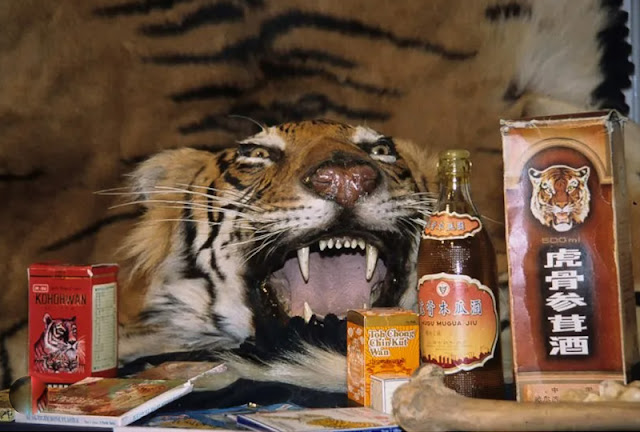
This is a highly contentious issue. It has been for a very long time. It affects tiger conservation dramatically. A research study published in 2008 provides us with some information about the attitudes of Chinese people living in China about eating bits of tiger and using Traditional Chinese Medicine (TCM) tiger products and the effect on conservation. Traditional Chinese Medicine tiger products which are hugely damaging to tiger conservation. Image: WWF The scientists surveyed 1,880 residents from six Chinese cities. In summary the results are as follows: 43% had consumed some products that were said to contain tiger parts (this points to the fact that some of these products may not have genuinely contained tiger parts but were sold as containing them) 71% of the respondents said they preferred wild products over farmed ones. This means that they believe that eating the body parts of wild tigers was more beneficial to them than eating the body parts of farmed tigers. You properly kno...

Chinese conservation efforts to save the South China tiger (2023)

Image
In 1997 a study was conducted on the decline and impending extinction of the South China tiger. The conclusion of the scientists was indeed very black and depressing. The scientists concluded that no wild South China tiger had been seen by officials in the wild for 25 years. The last one to be brought into captivity at that time was 27 years earlier. Some more black news was that the 19 reserves listed by the Chinese Ministry of Forestry included habitat which was and is fragmented. The fragmented sections were too small to support a viable tiger population. The reserves were useless in terms of tiger conservation. They stated that "over the last 40 years wild populations have declined from thousands to a scattered a few". They also confirmed that there were some occasional sightings of tigers in China but apparently no "intensive field study" had been conducted on the South China tiger and its habitat. At that time the captive population of tigers was 50. The South...

Striking a balance between tourism to fund tiger conservation and disturbing the tigers

Image
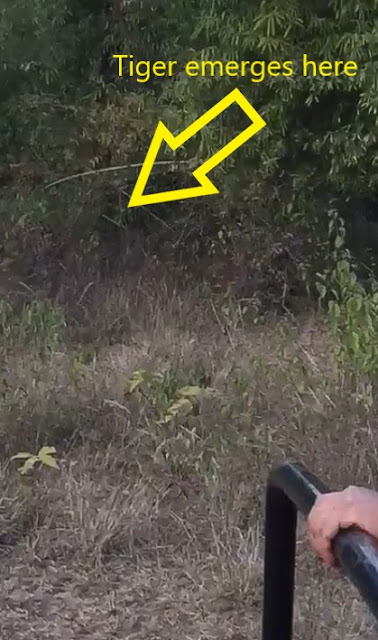
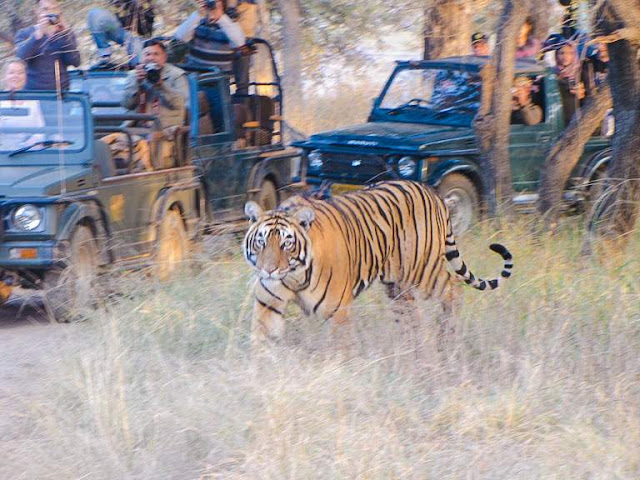
This is a video from Twitter which indicates to me that the managers of this tiger reserve (and I don't know which one it is) have got things wrong. They have allowed too many tourists in vehicles to visit the reserve which is disturbing the tigers.  Striking a balance between tourism to raise money for tiger conservation against disturbance to tigers. The pictures are from different reserves. Image by MikeB of PoC. These disturbances cause stress in tigers. Tourists in vehicles can upset the behaviour of tigers. And I'm going to suggest that the stress element can become so serious that it can prevent matings and of course successful breeding is part of tiger conservation. A critical part. There is a very difficult balance to be struck between allowing tourists to visit a tiger reserve to raise money to maintain the reserve to, in turn, benefit the conservation of tigers in India and the negative impact that tourists can have on tiger conservation if there are too many of them...

Video example of how tourists can annoy tigers

Image
It is the best I can do as the video quality is poor. 😢😒 This is a short Twitter video. It is not a great video, but it does make a clear statement about tourists interfering with tiger behaviour and irritating tigers. This video was probably captured in one of the many Indian tiger reserves and you initially see the camera focused on the bushes. After a little while, the tiger rushes out towards the vehicles. Sometimes, our ‘too much’ eagerness for ‘Tiger sighting’ is nothing but intrusion in their Life…🐅 #Wilderness #Wildlife #nature #RespectWildlife #KnowWildlife #ResponsibleTourism Video: WA @susantananda3 @ntca_india pic.twitter.com/B8Gjv8UmgF — Surender Mehra IFS (@surenmehra) November 27, 2022 The person operating the smart phone capturing the video is so struck by the aggressive approach of the tiger that they are unable to continue filming and the camera pans left and then it comes back to the tiger who then decides to retreat. It is a statement by the ...

Tigers seriously stressed by armies of camera carrying tourists in tiger reserves

Image
It has been known for a long time, but a study confirmed that tigers don't like the presence of tourists. The stress levels, as measured by the amount of stress hormones in faeces, are such that it can be a barrier to mating and breeding thereby seriously undermining conservation efforts. "Tourists can both promote conservation and damage it." - Michael Tourist vehicles near a tiger at Sariska Tiger Reserve. Photo by Subhadeep Bhattacharjee The tiger is on its knees in terms of conservation, so this is important. Tourism helps to fund the reserves. Almost all Bengal tigers are in India's tiger reserves nowadays. It is a tricky problem to crack. But the study (' Physiological stress responses of tigers due to anthropogenic disturbance especially tourism in two central Indian tiger reserves '. Conservation Physiology ) calls into question the modus operandi of the tiger project conservation program. Tigers in reserves are great money spinners. One tiger is said ...

Why should tigers be protected and saved?

Image
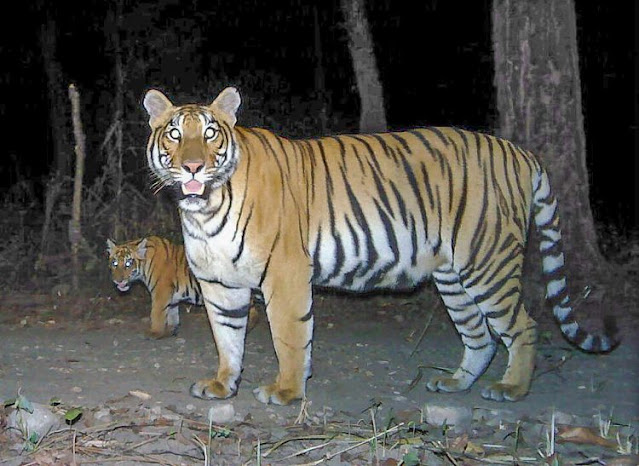
Tigers are becoming extinct in the wild year-on-year. This is despite the best efforts of conservationists. Their efforts aren't enough in the face of exploitation by big business such as the traditional Chinese medicine marketplace which results in poaching Bengal tigers in India for example. The carcasses are shipped over via Thailand. It's horrible. There are other reasons such as habitat destruction which gets worse as human population grows. So, tigers are going extinct in the wild. Bengal tiger in Nepal. Image: Nepalese government. Why protect them? Well, I can think of two main reasons (1) tigers are an iconic species with which we share the planet. They were here before us. And (2) top predators have a very important place in the ecosystem. Iconic species Do we, humans, have a right to eradicate such a beautiful, iconic species from the planet with whom we are meant to share nature? I don't think we have the right to kill them off. We think we do but that's beca...

Communist Party of India say people's livelihood should not be undermined by tiger conservation

Image
NEWS AND COMMENT-Sathyamangalam, Tamil Naidu, India: Sathyamangalam is a town and municipality in Erode district in the Indian state of Tamil Naidu. It is near the Western Ghats. There are rolling landscapes covered with dense forests. They have some beautiful tiger reserves. The Sathyamangalam Tiger Reserve is located there with 80 tigers. The reserve is contiguous with other reserves. Clearly, tiger conservation is important in the area and a major part of the lives of the citizens. Tamil Naidu has five tiger reserves and 15 wildlife sanctuaries and national parks. Sathyamangalam Tiger Reserve. Picture in public domain. However, the Communist Party of India (CPI) spokesperson in a meeting to discuss measures to protect the livelihood of tribal people and other forest dwellers stated that tiger conservation should not undermine the livelihoods of the hill people. This was a reference to an order passed by the Madras High Court that banned vehicle movement during night hours on Dhimbam...

Bali tiger has been extinct for about 70 years

Image
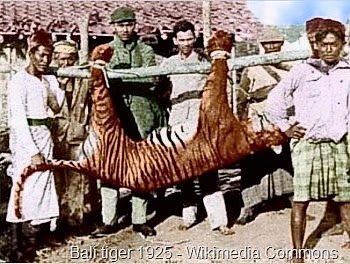
This is a little-known tiger subspecies which I've recently written about. I focused on the extinction of this tiger . Back in the day, at the beginning of the 20th century, tigers were considered to be pests and nuisances. Bloodthirsty Europeans who were well-healed made their way to Asia to take pot shots at tigers including those on the island of Bali.  Bali tiger. It is said that they tied baits like goats to posts and under or around the goat they placed a leg trap. The tiger approached the goat and was trapped in the jaws of this clamp whereupon the great White Hunter shot the tiger at point blank range. They then went home and tell their wives and children what wonderful hunters they were. It is all very sad. In addition to being hunted to extinction probably before the 1950s, the Bali tiger was also pushed off their own land by human population growth and expanding human activities including plantations which destroyed their habitat. And humans have an insatiable appetite f...

Failure in repopulating tiger reserve exposes India's tiger conservation weaknesses

Image
NEWS AND COMMENT: Atkosia Tiger Reserve is located in the Angul district of Odisha, India covering an area of 988.30 km². A plan to repopulate the reserve with tigers has failed miserably with a catalogue of disasters. Sad failure in tiger conservation in India. Photo: The Hindu file photo. A tigress imported into the reserve (one of a pair) has been removed from the reserve to be returned to Madhya Pradesh. The tigress's name is Sundari. The tiger was kept in a special enclosure inside the Satkosia Forest before removal. A final act of failure. Before the return of Sundari it was claimed that the reserve had abundant prey and the management had asked for fresh tigers.  In the first year of the repopulation a tiger was gifted from Kanha and a tigress from the Bandhavgarh Tiger Reserve.  The tigress strayed into a human settlement surrounding the reserve and killed two people. And then, in Nov 2018, the first tiger was killed by poachers. Comment : poaching of Bengal tigers ...

Artificial insemination of a captive Amur tiger killed her

Image
COMMENT AND REPORT ON TIGER NEWS: This is a tragic story because the Amur tiger is rare. There are desperate measures being taken to protect and conserve this iconic animal. They live in the Far East of Russia, in that icy wilderness of birch trees and snowy landscapes. They are large animals. They've evolved that way to keep warm in the cold climate. It is believed that there are 500 left in the world. This puts pressure on zoos to try and breed them successfully.  Artificial insemination of a captive Amur tiger killed it. Photo: Cheyenne Mountain Zoom. Tigers usually breed well in zoos but in this instance, at Cheyenne Mountain Zoo in Colorado Springs, Colorado, USA, they tried artificial insemination of a female, Savelii, because their resident male wouldn't mate with her to produce offspring naturally. The operation went badly wrong and it killed her. A spokesperson for the zoo, Bob Chastain, said that: "She passed due to complications during recovery from this impo...

Counting Tigers

Counting tigers is notoriously difficult, in part because they are very secretive. They need to be to survive the activities of people. "Subjective judgments" have to be made. When you do that self serving interests can get in the way of making good judgments! The tiger count in India was overestimated at one time and it came as a shock when the figure was revised downward. It is almost possible to image the scenario whereby the tiger becomes extinct in the wild without people knowing about it. In the old days counting tigers was carried out by pug marks and scats. "Pug marks" are the footprint of an animal. The word "pug" means "foot" in Hindi. "Scats" are fecal droppings. Camera traps are also used. These are cameras mounted on trees, rocks and such objects which fire off when a tiger passes in front of it. The positioning of the camera has to be assessed accurately and with wisdom. Both camera traps and radio collars are relia...

World Tiger Populations

Here's a table showing world tiger populations at the date of this post: Please note that counting the number of wildcats, whatever the species or subspecies, has in the past been notoriously unrealiable. The process is better managed now, probably because of the increased use of camera traps (cameras that fire off on movement in front of the camera). But there is still political interference I would argue. However, these figures, as you can see go back to 2004 at best. That is 7 years ago and quite a lot can happen in 7 years in respect of tiger populations particularly in relation to the tigers in south Asia where habitat (forest) is being consistently eroded for commercial reasons. Human population size and growth is still high in India and Bangladesh. The Siberian tiger population is stable but fertility is poor amongst the tigers resulting in an effective population in the far east of Russia, in terms of reproduction, of 14 individuals .

Bengal Tiger Populations Sunderbans

These are Bengal tiger population figures for the Sunderbans Tiger Reserve and adjacent area in West Bengal, the South 24 Parganas, West Bengal, India. This is a map of South 24 Parganas, West Bengal, India: View Larger Map And this is a map of the Sunderbans, a large mangrove swamp and one of the largest Bengal tiger reserves: View Larger Map You can see and read more about the Indian Bengal tiger reserves if you wish.

South China Tiger

Image
I have said that the South China tiger subspecies ( Panthera tigris amoyensis ) is totally extinct - captive or wild . That may be a rash statement but it is based on sensible thought and real information. As at 2002, on the publication of the Sunquist's renown Wild Cats Of The World , of the five-remaining subspecies of the tiger (I say it's four now) the South China tiger was the most endangered. Tiger farm - Photo by International Tiger Coalition The decline in population was rapid at the end. In 1949 it was thought that there were 4,000 individuals. However, this fantastic animal was "declared a pest" and mercilessly persecuted. I can understand one aspect of this. The tiger is hard to live with because it is a very large and a potentially dangerous animal. Humankind has great difficulty sharing the planet with it. But the main reason for its decline is Chinese medicine. Please note that I am not being judgemental. I am simply describing what has gone o...

Translocating Felids and Sariska Tiger Reserve

You may have heard about the loss of all tigers at the Sariska tiger reserve. It was a highly embarrassing situation for Project Tiger - now National Tiger Conservation Authority (NTCA) -  management. It gradually dawned on management what had happened in and around 2004. The loss of all tigers from poaching was confirmed in January 2005. There were 15 tigers at the Sariska tiger reserve before they were poached. They probably all ended up in tiger bone wine and medicinal products in Asia. This is tragic for people who care. There has been a gradual restocking of the park. And it seems to be very gradual. Two tigers, a male and female, were translocated in 2008. And a search of the internet indicates that as at 2011 there are five tigers (2 males and 3 females) and two new translocated cubs. Cats are reportedly poor travellers, meaning poor at translocation and introduction to new habitats . This is due to the land tenure system employed by tigers and all wild felids. Also br...

20% of Tigers Missing at Ranthambore Tiger Reserve!

Image
As at the date of this post four tigers are "missing" at Ranthambore National Reserve. The authorities don't know the exact number of tigers at the reserve but an estimate is around 20. A very low figure but it is a small reserve (too small you might say). So a loss (temporary?) of four represents a twenty percent loss. Of course they may turn up but then again they may not. What chance that they have been poached? Poaching and corruption of officials that supports poaching is dire in the conservation community in India it seems to me. The reserve is 12 km from Sawai Madhopur town. There is a train station at Sawai Madhopur. Biodiversity of Ranthambhore Tiger Reserve, Rajasthan

Tiger Conservation is a Long Term Failure

We have to conclude that tiger conservation as a whole and in the long term is a failure. This is not necessarily to criticise conservationists. It is simply that a dead tiger as a product to supply the body parts trade is more valuable than a live one and the short term benefits of that simple fact drives poaching and corruption in what are still relatively poor countries in which the tiger finds itself. Where there is human poverty within the tiger range there is bound to be poaching. Commercial interests always outweigh conservation because commerce is richer. If conservation has failed why give money to fund conservation? Good question. We either change tactics completely in respect of conservation or we decide that we don't want the tiger living in the wild anymore and go to the end game. At the moment it is the slow drip, drip of conservation failure that is leading to one conclusion: the extinction of the tiger in the wild. The tiger is actually becoming extinct in c...

Mining Operations Engander the Tiger

There are countless examples where mining operations have a huge impact on the survivability of the tiger in the wild. If it's not mining it is deforesting and logging and if it is not the tiger it is some of the wildcat or wild animal. Big business want to mine for all manner of ore to fed the market for consumer products primarily manufactured in China. China has a huge and growing appetite for metals of all kinds to manufacturer electrical and electronic goods. That is why they have invaded Africa and are digging it up. They will wreck the landscape in Africa and no doubt endanger the lion there. There are upsides though in terms of wealth creation at least potentially. In Goa there is the classic battle going on between business and conservation. Conservation almost invariably loses because there is more money in business. There is believed to be a tiger in Goa! Actually there has to be more than one and the second one has to be a different sex to the first one if there i...