Posts

Showing posts with the label tiger cub

Wild tiger cubs are adorable, but I think of their vulnerability

Image
When you see super vulnerable tiger cubs following mother in the wild, it is max. cuteness. They are so tiny. You feel that they might not survive even with the careful attention of their mother as she has to disappear for periods of time find a meal. And she can't be sure how long it will take. She'll hide her cubs, but other predators may take advantage. So, what do the books say about predation rates in tiger cubs in the wild? The mother stays with her young cubs during the first few weeks of their lives. Her movements are therefore restricted. Tigresses are cautious and secretive when they have young cubs. They move them around frequently if the den is disturbed or threatened. Cubs begin to follow their mother when they are about two months old. They don't join her in the hunt but wait quietly until she calls them. The mother takes a lot of care to avoid placing her cubs in danger. By six months of age the cubs are weaned but they can't kill for themselves. I would ...


Black tiger cub in the wild

Image
This tiger cub with their mother is described as a 'black tiger cub in the wild' by the ranger in his tweet. The cub is not entirely black. It is only melanistic wild cats which are near black with faint markings. This cub is what is called a pseudo-melanistic tiger cub. It brings to mind a pseudo-melanistic tiger cub that was born in Oklahoma zoo but was killed by their mother. The cub's body was preserved as a curiosity.  Black tiger cub in the wild. Image: Twitter page of Susanta Nanda. This is due to a genetic mutation. If this is a recessive genetic mutation, which it is as far as I know, the inbreeding of the tiger is going to allow this mutated recessive gene to come forward and show itself in terms of phenotype i.e. the appearance of the tiger.  It is only through inbreeding that this recessive gene has the chance to work and dictate the nature of the coat. To the best of my knowledge, there are no confirmed reports of pure black non-striped tigers i.e. true melan...

Tiger 'herd' - mother and five cubs (video)

Image
The Indian Forest Service official, Susanta Nanda, says in his tweet that this is a 'herd of tigers' because of the number of offspring which is 5. Normally around 4 is the maximum and my book on the tiger states that a tigress "may give birth to 1-7, although a tigress in the wild is rarely accompanied by more than 2 or 3 cubs. In Nepal, the average size of 49 litters was 2.98. In zoos, the average litter size at birth is 2.8, and an equal numbers of males and females are born". A Bengal female tiger and a 5 cubs which is rare because the average litter size prey tiger is around 2.8 The official is correct and therefore this is an unusual video and a good one because it not only shows us the tigress and cubs but the way the wildlife officials and indeed the way tourists see tigers in their natural habitat. Although, it is said that, if there are too many tourists it disturbs the tigers to the point where they can no longer behave naturally. If you haven’t seen a tige...

Do tigers kill tiger cubs?

Image
There are records of males killing cubs, and some of these instances of infanticide occurred at kills. So for young cubs, the vicinity of a kill can be a dangerous place because of the likelihood of encountering other tigers there.  Tiger cubs are vulnerable to being killed at kill sites by adult male tigers. Photo: Pixabay. The words are quoted verbatim from the book Wild Cats of the World . I take the words to mean that at a kill site where there is competition to eat the carcass of an animal, male tigers will kill a much smaller tiger i.e. a cub, to ensure access to the food.  To the best of my knowledge, tigers do not kill cubs in order to bring the mother into heat so that they can procreate and generate their own offspring. Tigers don't do this or at least my research indicates this. But lions do. My research also indicates that sometimes in India's tiger reserves they use a buffalo, a live buffalo actually, as bait to draw tigers into an area so that tourists can wat...

Sumatran tiger cub in Le Havre, Normandy illustrates illegal trade in tigers

Image
Another bizarre tiger story. A French couple living in France wanted to purchase a high filial Savannah cat which you might know is a serval-domestic cat hybrid. They bought the cat online but were delivered a Sumatran tiger cub instead. Extraordinarily, they did not know that they had taken possession of a tiger until a few days later when they contacted the police. They purchased the animal for €6000. Savanah cats and tiger cubs have a completely different appearance by the way. Tiger cub. Stock image from EPA. The Sumatran tiger is highly endangered. The trade in wild kittens of any species is arguably out of control. There are international treaties (CITES) in place to protect wildlife from this kind of trade but they are unenforced or the enforcement lacks teeth. If it isn't tiger cubs it'll be tiger body parts which are traded to feed the traditional Chinese medicine market in China. Lion bones are also popular which causes no end of lion abuse in Africa. This rather o...

Tigress protects her young and is extremely cautious and secretive

Image
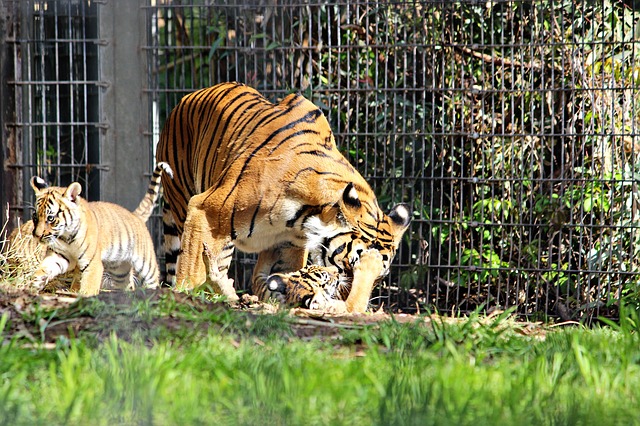
We know that cats protect their young with courage and aggression if needs must. Tigers are no exception. Tigresses are very cautious and secretive when they are caring for their cubs. When disturbed they will move the cubs to a new den. Here are two examples from Wild Cats of the World (page 359). In Ranthambore National Park a tigress hid her cubs near a main road. It was the time of year when the road was used by pilgrims so it had become busy. The tigress threatened the pilgrims and then moved the cubs to a safer location. Tigress with her cubs in captivity. Image by nlw143 from Pixabay   In Chitwan a tigress charged at villagers several times in protecting her 6-week-old cubs. The villagers had approached her den while cutting grass. Eventually the mother moved her cubs out of harm's way. This tigress also attacked a researcher in a tree because he or she got too close to her 4-day old cubs.  In captivity tigresses spend 70 percent of daylight nursing he...