
Posts

Showing posts with the label human activity

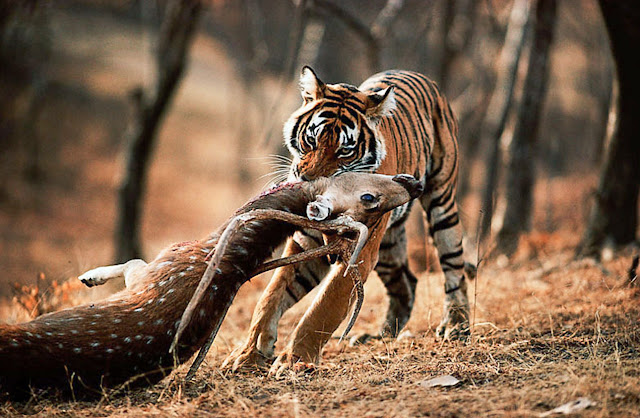
When are tigers most active in the wild?
Image
There would appear to be two factors which influence when tigers living in the wild are most active: Human activity Prey activity Human activity In a way this behaviour is reminiscent of the leopard. The tiger, in many parts of their range, have become totally nocturnal as a response to human activities. In other words, in areas where the human is active during the daytime, this has put off tigers being active themselves during the daytime and in order to avoid humans they have become nocturnal. It shows that tigers can be both nocturnal and daytime hunters. It also shows us that tigers are wary of people and don't really want to get involved with them. This might surprise some people who think that tigers prey on humans. They don't. The human is not a prey animal for the tiger. Tigers have quite nice dispositions (character). You will find that where tigers attack people it is often because they can no longer attack large prey animals (which they need to attack to survive) bec...

How infrastructure development harms tiger conservation in India

Image
This is a classic and very instructive video from India showing how roads and traffic carve up a tiger's home range fragmenting it and killing tigers both through traffic accidents and creating small, unviable sub-populations where genetic diversity is problematic leading to inbreeding and health issues plus sterility. The following quote comes from the IUCN Red List. The people who run the database are the experts on species becoming extinct. The text in brackets is the source of the information. These are scientific studies. "Habitat fragmentation driven by linear infrastructure development, land-use change, and urbanization can drive the extinction of tiger subpopulations (e.g., Mondal and Nagendra 2011, Joshi et al. 2016). Tigers can become locally or functionally extinct in areas where habitat connectivity is severed or severely compromised (Gopal et al. 2010; Harihar et al. 2018b, 2020)." They talk of habitat connectivity being compromised. This means that areas of ...