Posts

Showing posts with the label Tiger ecology

10 facts on tiger ecology and behaviour in an infographic

Image
  I hope it helps a bit to understand the tiger. Please feel free to comment.

Range size of female and male Siberian tigers

Image
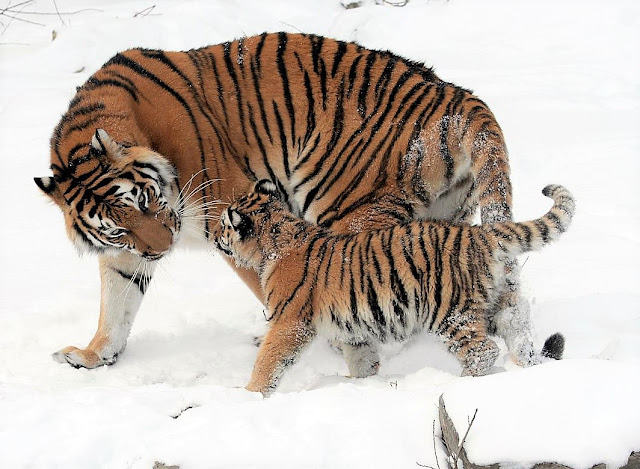
Female Siberian tigers in Sikhote-Alin are estimated to have a range of 200-400 km². Male Siberian tigers have a range size between 800-1000 km². These range sizes have been estimated based on radio tracking data. The range of each male tiger overlaps with 1-3 females "but male ranges overlap almost completely". However, males do not use the same area at the same time. Between females, there appear to be no overlaps or little overlap between the ranges of neighbouring adult females. Siberian tiger in the snow with cub. Photo: Pixabay. The range sizes of Siberian tigers are considerably larger than those of the Bengal tiger. The differences are due at least in part to differences in prey density and because the prey is migratory in Siberia. Male and female tigers communicate through a combination of scent marks, visual signals and vocalisations. In the area mentioned, in Siberia, Sikhote-Alin, Siberian tigers live in a mixed coniferous and broad-leaved deciduous forest. The la...

How Tigers Kill

Image
Tigers use two techniques to kill prey depending on prey size. Image by  Gerhard G.  from  Pixabay   Small Prey Small animals are usually killed with a bite to the back of the neck. This is mirrored in the killing technique of domestic cats (a bit to the nape of the neck severing the spinal cord). A canine tooth (the large teeth at either side of the mouth at the front) is inserted between the vertebrae forcing them apart which severs the spinal cord. This is a precise action. In domestic cats the whiskers play a significant role in feeling the position to bite especially in the dark. Cats "have numerous mechanoreceptors associated with the canines". It is thought that the tiger can feel with the canine teeth to position them between the vertebrae. The jaws contract very fast. Perhaps the jaws contract and expand to let the tips of the canines position and reposition by feel until the correct location is found. The success rare concerning positio...

Javan Tiger

What caused the extinction of the Javan tiger? It is really a story about the usual culprit - humans. In the 1800s tigers were widespread in Java. The forests of Java were the tiger's habitat. The forests were "converted to teak" (1). So the tiger's habitat was despoiled by people. The lost of tiger habitat forced the Javan tiger to find sanctuary in inaccessible places on the island. By the 1970 the tiger lived on the southeast coast of Java on the Meru-Betiri Reserve. The reserve was not good tiger habitat. Deer, the prey of tigers, was hunted. Hunting of deer in combination with rapid human population growth lead to a rapidly declining deer population. By the 1950s deer could only be found outside reserves or sanctuaries. And these places were few in number. Another prime tiger prey, the wild boar was slaughtered under government directive by poisoning.  The only abundant prey for the tiger was primates with very low boar numbers. Javan tigers at this tim...

Bengal Tiger Prey

This is a chart showing the Bengal tiger prey profile for the Nagarhole National Park (Nagarhole is sometimes spelled "Nagarole"). The data was first published in 1995. Tiger prey is also hunted, poached or lost in some other way and therefore the profile as at the date of this post may be somewhat different. The source of the information is Wild Cats Of The World table 64 (authors: Mel and Fiona Sunquist). The authors of this fine work obtained the information from "Prey selection by tiger, leopard and dhole in tropical forests" by Karanth KU and ME Sunquist. Nagarhole NP is in the southwest of India. See all the tiger reserves of India .

Tiger Ecology, Behavior and Social Organisation

Image
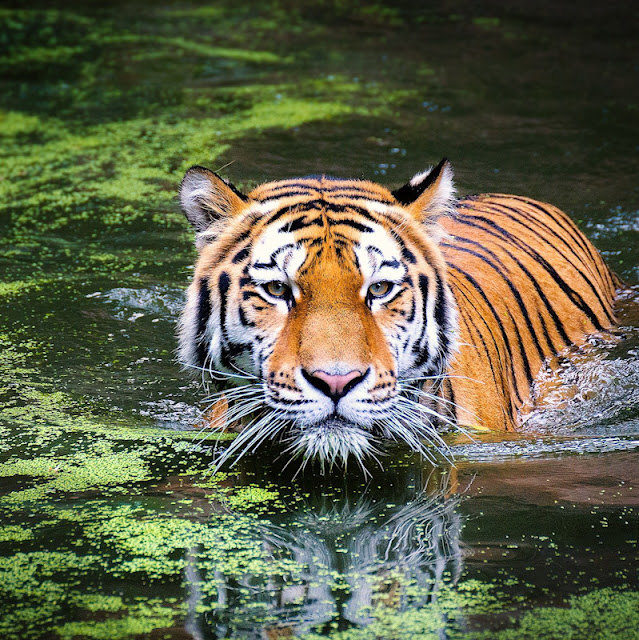
Bengal tigers like to spend the heat of the day in water to dissipate their body heat. Image in the public domain. The tiger is adaptable in terms of habitat and climate. The tiger is very athletic. It can climb well when needed and swim exceptionally well (by human standards) when required (2 miles in sea water - see Lion vs Tiger ). What they need is water and large prey (ungulates - hooved animals) to survive. The best prey base in Asia is where there is a mosaic of forest and grassland 7 . The environment that suites the tiger also suites the leopard and the wild dog (dholes).  Tiger Attacked and Killed by Dogs. Image: Public domain. A pack of wild dogs can kill a tiger 7 . But the tiger can dispatch a leopard at will. The leopard steers clear of the tiger, accordingly, despite sharing the habitat with it. Where there is a reasonable tiger population the leopard population is reduced. In Siberia it is outgunned by the bear. Sambar deer. Image: public domain. The scope...