Posts

Showing posts with the label mothering

When do tigers become independent?
Image
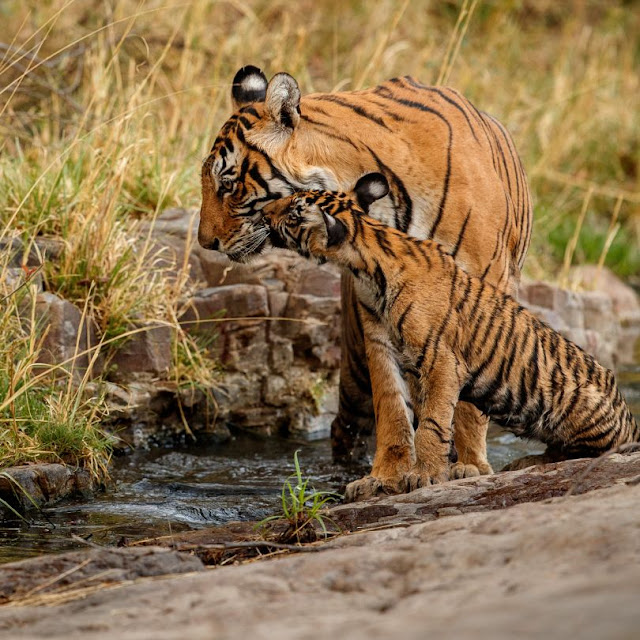
D. Smith in his work: "The role of dispersal in structuring the Chitwan tiger population" (1993) found that young tigers became independent of their mothers at seventeen to twenty-four months of age. They continued to hunt within the natal range (the home range of their mother effectively).  When do tigers become independent? 17-24 months of age. Image: MikeB This allows them to hone their hunting skills in relative safety. After doing this for a few months the young tigers 'dispersed' (left) from the natal range to find their own range at between 18-24 months of age. Male cubs learn to kill on their own and become independent earlier than females. By 15 months of age males often leave their mother for several days at a time to test independence. Females stay with their mother for longer. RELATED:  Bengal tiger travels 1300 km to find his home range and a mate . A sister and brother, both 18 months old, were watched for their behavior at this stage of their developmen...

Tiger 'herd' - mother and five cubs (video)

Image
The Indian Forest Service official, Susanta Nanda, says in his tweet that this is a 'herd of tigers' because of the number of offspring which is 5. Normally around 4 is the maximum and my book on the tiger states that a tigress "may give birth to 1-7, although a tigress in the wild is rarely accompanied by more than 2 or 3 cubs. In Nepal, the average size of 49 litters was 2.98. In zoos, the average litter size at birth is 2.8, and an equal numbers of males and females are born". A Bengal female tiger and a 5 cubs which is rare because the average litter size prey tiger is around 2.8 The official is correct and therefore this is an unusual video and a good one because it not only shows us the tigress and cubs but the way the wildlife officials and indeed the way tourists see tigers in their natural habitat. Although, it is said that, if there are too many tourists it disturbs the tigers to the point where they can no longer behave naturally. If you haven’t seen a tige...

Tigress carries a fawn in her mouth as if she is carrying her own cub

Image
This is one of those extraordinary pictures of a huge predator, a tigress, not killing and eating a prey animal that is right next to her. But rather than kill and eat this fawn the tigress appears to be relating to the young animal as one of her offspring.  Tigress carries a fawn in her mouth as if she is carrying her own cub. Photo: Instagram. Perhaps she is pregnant (see looks it) and those mothering emotions are coming out and dominating the emotion to attack, kill and eat. And sometimes tigers are curious so they don't always (albeit very rarely) kill and eat prey animals.  We have seen it before in fact with large predators, particularly big cats. I've seen a leopard playing with a young antelope, for example.  I guess sometimes these encounters start like this but lead to the death of the prey animal because the instincts of the tiger are somewhat jumbled up and at the end of the day the dominant instinct is to kill.  Notwithstanding that I am reassured tha...

Tigress protects her young and is extremely cautious and secretive

Image
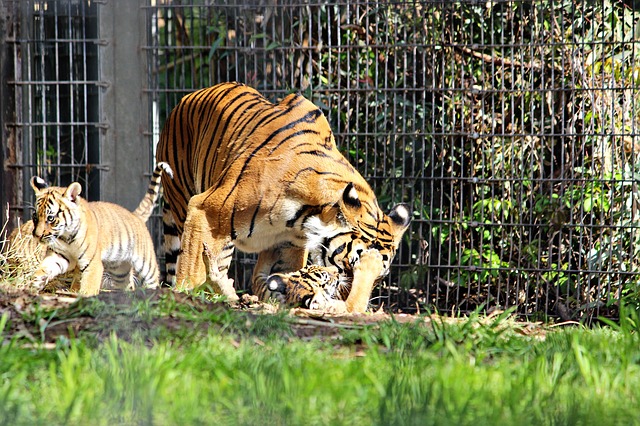
We know that cats protect their young with courage and aggression if needs must. Tigers are no exception. Tigresses are very cautious and secretive when they are caring for their cubs. When disturbed they will move the cubs to a new den. Here are two examples from Wild Cats of the World (page 359). In Ranthambore National Park a tigress hid her cubs near a main road. It was the time of year when the road was used by pilgrims so it had become busy. The tigress threatened the pilgrims and then moved the cubs to a safer location. Tigress with her cubs in captivity. Image by nlw143 from Pixabay   In Chitwan a tigress charged at villagers several times in protecting her 6-week-old cubs. The villagers had approached her den while cutting grass. Eventually the mother moved her cubs out of harm's way. This tigress also attacked a researcher in a tree because he or she got too close to her 4-day old cubs.  In captivity tigresses spend 70 percent of daylight nursing he...