
Posts

The first recorded captive tiger in England

Image
The exact date of the foundation of the royal menagerie appears to be uncertain. My source tells me that around 1120 King Henry I established a 'flourishing menagerie near Oxford which included the first recorded captive tiger in England'. Royal menagerie in 1816. Picture in the public domain. Another source tells me that the menagerie was founded at the Tower of London during the reign of King John (1199-1216). I favour the first date!  On that basis, the menagerie was moved to the Tower of London about 100 years after it was established.  The animals were gifts from other royalty. Various other tigers were presented to the Crown by rulers such as Frederick II, the Holy Roman Emperor. The zoo was closed to the public until the middle of the eighteenth century (around 1750). Until then royalty and guests were allowed to see the animals which were rare and exotic to the English of that era. Knowledge of managing captive animals was relative poor and it is said that many died...

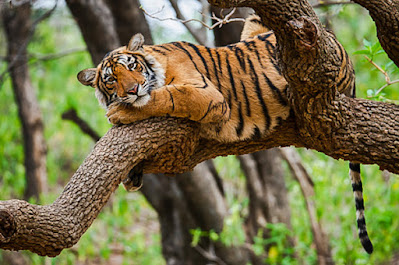
How much space do tigers need?

Image
Tigers need an enormous amount of space when they live in the wild and I believe that they still need that kind of space when in captivity even if they were born in captivity because this need is inherited. I believe that it is hardwired into their DNA. On that basis life in a zoo for a tiger is uncomfortable, sterile and without enjoyment except intermittently. And I am referring to good zoos in the West. What about the crappy zoos in Asia where we see tigers pacing to survive mentally. It is horrible to see. I shake my head when I think of it because I don't know how people can put tigers through that kind of mental torture. Only ignorant people can do it. Tiger in captivity. Photo: Pixabay I do not believe that it makes any difference whether a tiger is born in captivity, in a zoo, or whether they are born in the wild. They need a certain amount of space in order to express their natural behaviour. It is an enormous amount of space. It depends upon where the tiger lives in the w...

When do tigers become adults?

Image
I can call upon Mel and Fiona Sunquist again to answer the question in the title (Wild Cats of the World). In relying on the work of JLD Smith and C McDougal (1991 - The Contribution of variance in lifetime reproduction to effective population size in tigers ), they state unequivocally that ' tigers continue to grow and put on muscle until they are about five years old ; this prolonged period of growth is more evident in males than in females '. When do tigers become adults. At about 5. Photo: Pixabay So tigers become adults at around five years old. This reminds me the often quoted statement that the Maine Coon domestic cats becomes a mature adult at aged four. They, too, are relatively slow developers. Male tigers become sexually mature at three to four years of age and they normally take longer than females to acquire breeding territories. At about three years old females become sexually mature. They conceive about six months later. A tigress might have her first litter w...

How do tigers mark their territory?

Image
Briefly, male and female tigers mark territory by cheek rubbing, claw raking, urine spraying, scraping with their hind feet, and through depositing uncovered and scattered faeces. In addition the male tiger also head rubs. Tiger cheek rubbing. Camera trap image in the public domain. In rubbing various parts of their anatomy against objects such as trees and rocks the tiger and tigress are depositing scent from their glands which are located at this areas of the bodies . The scent is picked up by other tigers who can recognise the other tiger by their scent and will know when they were there by the deterioration in the strength of the scent. These marking behaviours are very similar to those of the domestic cat as you will no doubt recognise. Not only are the tiger and cat very similar in their anatomy except for their size they are very similar in their general behaviour. "Scent is deposited as an odorous musky liquid known as 'marking fluid'". It is mixed with uri...

Tiger count and distribution 2014

Image
Here are two images which provide us with a tiger count for 2014 and the distribution of the tiger at the same date. It seems to me that the IUCN Red List's data stops at 2014. I have found this with other cat species. What is happening? A lot can change over 7 years. A hell of a lot in fact. The IUCN Red List needs to update its information annually at the very least. Am I missing the point or something? No idea. World tiger count at 2014 is 4,240 according to the guys who should know: IUCN Red List. This is a screenshot from their PDF file. I have taken a liberty in lifting these images from their PDF files but I do so for educational purposes. I was surprised that they came up with the number of 4,240 tigers left in the wild on the planet. That is more than I had thought. How accurate is their information? It is certainly out of date and it is an estimate. Can't trust it I am afraid. This information should be treated as guidelines only. Where was the tiger found in the w...

How many stripes do tigers have?

Image
In answering the question I took a common sense approach. Taking one side of a tiger and counting the stripes on one side of the face, the stripes on one leg, the stripes on the flank, the stripes on the hind legs and the tail (counting half of them) I came up with around 60 stripes which I had to double making a predicted 120 stripes on a tiger!! Amur tiger. Image by TheOtherKev from Pixabay   That is pretty crude I guess. Essentially, I counted the stripes on one side and doubled it. The problem is that the stripes are not nice and neat. They are irregular and broken. This obviously makes counting them imprecise. They are actually stretched out spots. It is a bit like the mackerel tabby domestic cats. Their stripes are joined up dots. But I don't think the person asking the question would mind. I counted the stripes on a Sumatran tiger. I would expect the same result on other species of tiger, plus or minus around 10-20 stripes. It can't be an accurate process. ...

Tiger's coat is conspicuous in a cage but good camouflage in the wild

Image
We are all familiar with the tiger's coat; its pattern of sharp dark stripes against a reddish-orange background with a splattering of white here and there. It looks as if it would not be good camouflage in the wild because in a cage it stands out very starkly. Some people ask why the tiger developed such a coat when it makes the animal more conspicuous. Image by Andreas Breitling from Pixabay   But nature finds a way to help with survival and evolution is always correct. There are perhaps three major points to make about the pattern and colour of the tiger's coat which justifies its creation through evolution. Variable habitat The tiger is found in a variety of habitats and sometimes it's a quite orange, warm coloured environment broken up by vegetation. The orange colour of the coat fits nicely into this landscape. Dappled sunlight The tiger is often in a forest setting under dappled sunlight shafting through the canopy of the trees and under these conditions th...